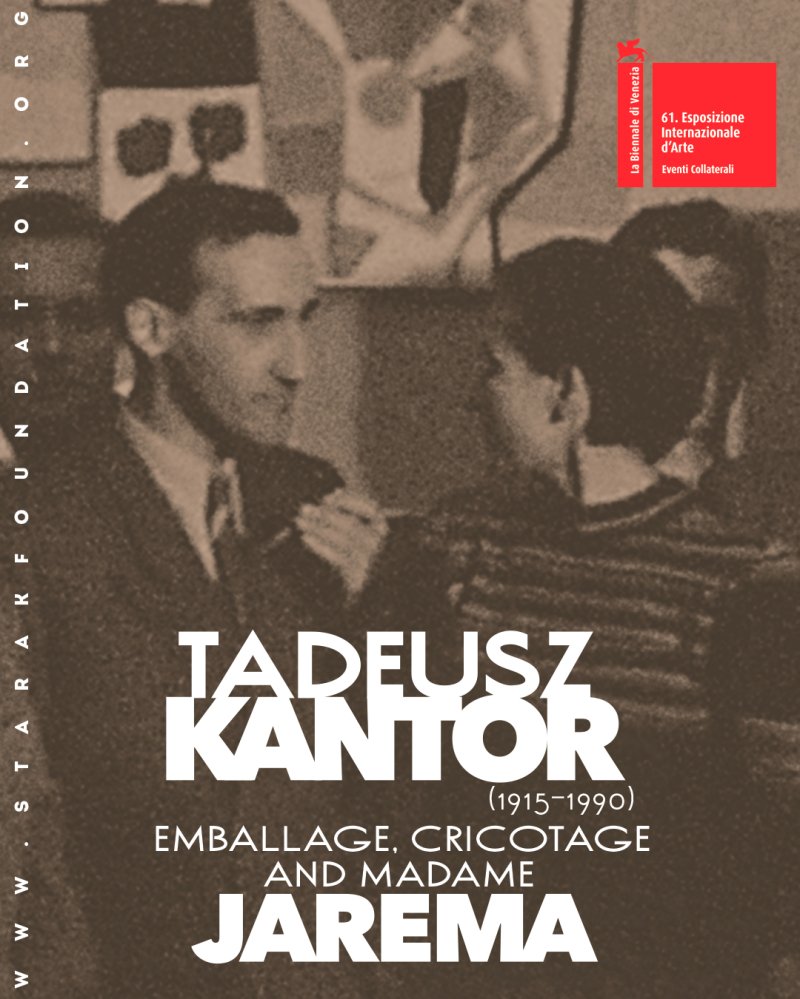
Tadeusz Kantor (1915-1990). Emballage, Cricotage and Madame Jarema
Collateral Event of the 61st International Art Exhibition – La Biennale di Venezia
May 9 – November 22, 2026
Location: Procuratie Vecchie, Piazza San Marco 139 – 153/A 30124 Venice
Founders: Anna Woźniak-Starak i Jerzy Starak
Promotor: Fundacja Rodziny Staraków
Curator: Ania Muszyńska
Curatorial Team: Magdalena Marczak-Cerońska, Kama Kieremkampt
Anna and Jerzy Starak are among the most important and distinguished patrons of culture in Poland. Established in 2008, The Starak Family Foundation, pursues a consistent, long-term mission to promote education and disseminate Polish artistic heritage in Poland and abroad. They also own one of the most valuable collections of post-war Polish art, distinguished not only by its impressive scale but, above all, by its museum quality, coherence, and historical importance. The Starak Collection offers a unique record of key artistic phenomena of the second half of the 20th century and is fundamental to understanding contemporary Polish culture.
The exhibition Tadeusz Kantor (1915–1990). Emballage, Cricotage and Madame Jarema will be the fifth presentation of Polish art organized by the Starak Family Foundation in Venice including presentations of the work of Ryszard Winiarski (2017), Ewa Kuryluk (2022) and Andrzej Wróblewski (2024) as Collateral Events of the Venice Biennale.
The exhibition, as a further Collateral Event will take place from May 9 to November 22, 2026, once again in the historic and highly prestigious venue of the Procuratie Vecchie in St. Mark’s Square, the heart of Venice.
Tadeusz Kantor (1915-1990). Emballage, Cricotage and Madame Jarema is an exhibition devoted to the relationship and work of Tadeusz Kantor and Maria Jarema, leading representatives of the post-war avant-garde. Internationally acclaimed, Tadeusz Kantor was an artist whose work defined Polish identity in his impressive “Theater of Love and Death” giving it the dimension of a universal spectacle that seduced and fascinated audiences from Europe to Asia and the Americas. His theater, stage designs and directing, his modern understanding of acting combined with an extraordinary sensitivity touching on the most subtle strings of the human condition made the experience of his art interpreted with equal intensity regardless of where it was performed.
Tadeusz Kantor received numerous awards and honors for his artistic achievements. He received the international Rembrandt Prize awarded by the jury of the Goethe Foundation in Basel for his significant contribution to the development of contemporary art (1978) and the Italian “Targa Europea” award, given to outstanding representatives of culture and science in Europe (1986). He was awarded the French Legion of Honor (1985), the Order of Arts and Letters in the rank of Commander (1989) and the Grand Cross of Merit of the Federal Republic of Germany “for his significant impact on contemporary art in Europe and for his contribution to the revival of the cultural image of the Federal Republic of Germany” (1990). His theatre productions won international recognition and numerous awards, including the Grand Prix at the BITEF International Theatre Festival for The Dead Class (1977), the main prize at the European Season of Theatre of Nations in Rome for the same production (1978), the New York theater critics’ OBIE Award for the most outstanding off- and off-off-Broadway show (The Dead Class, 1979), the Teofilo Lea Order – Venezuela’s highest theater award (1980), the Spanish theater award “Audience and Critics” for the best foreign performance of the year (Wielopole, Wielopole, 1981), as well as the New York critics’ award for the best Broadway performance as director and actor in his play Let the Artists Vanish(1986).
The culmination that the Venice exhibition will lead the viewers to a projection of the recording of Kantor’s masterpiece production – The Dead Class (1975) combined with original theatrical objects – mannikins of students, girls and boys confined to school desks forever.
In the field of theater, Tadeusz Kantor remains an icon of global renown. In the field of visual arts, he is a fundamental figure in Polish post-war art history. He was the first in Poland to create expressive abstraction in the spirit of informel; he was the first to use the technique and possibilities of assemblage, the first to become fascinated with the idea of emballage and the first to introduce happening and performance. Thanks to his extraordinary awareness of avant-garde trends and an international network of contacts, he introduced current ideas into Polish art, interpreted them according to his own artistic concept and then abandoned them in search of new solutions. Tadeusz Kantor is one of the first interdisciplinary artists in the contemporary understanding of the term.
The exhibition in Venice will present the most important threads of Tadeusz Kantor’s painting accompanied by original props and objects from his performances, including a selection of informel compositions from the late 1950s and early 1960s, emballages from 1964-1978, and his last painting series, “Dalej już nic” (Further On, Nothing) (1987–1990) and “Cholernie spadam” ( I’m Goddamn Falling!) (1988–1990). An important remembrance of the process of creating informel compositions will be the film “Uwaga, malarstwo” (Attention, Painting) made by Antoni Nurzyński and Mieczysław Waśkowski based on Kantor’s concept. The film was presented for the first time during the 29th Venice Biennale and received a mention at the 1st International Art Film Competition as the only work of a non-didactic nature. Tadeusz Kantor was a featured artists in the Polish Pavilion at the following edition of the Venice Biennale in 1960,
An important theme of the exhibition will be the presentation of the work of MARIA JAREMA (1908–1958). As a co-founder of the pre-war avant-garde theatre Cricot and co-founder of Cricot 2, she was one of the key formative figures for Kantor. Maria Jarema, an outstanding painter and sculptor, awarded a prize at the Venice Biennale in 1958, remained the only person whose opinion Kantor fully trusted. Their relationship—a fascination and intellectual partnership—became the basis for the formation of Cricot 2. The exhibition will feature monotypes from the Starak Collection and her costume designs for Kantor’s early theatre productions: Mątwa (The Cuttlefish) from 1956 and Cyrk (Circus) from 1957.
The exhibition’s content supporter is CRICOTEKA – Centre for Documentation of the Art of Tadeusz Kantor. Cricoteka was founded in Krakow in 1980 at the initiative of Tadeusz Kantor to serve as a living archive of the Cricot 2 Theater. Cricoteka stores, presents and safeguards the collection of theatrical works from Tadeusz Kantor’s performances. Cricoteka is a museum, an archive, a gallery, and a research center all in one.
The exhibition will feature works by Tadeusz Kantor from the Starak Collection, Muzeum Sztuki in Łódź, and the Cricoteka collection, as well as works by Maria Jarema from the Starak Collection.
Copyright to all works by Tadeusz Kantor © Dorota Krakowska & Lech Stangret / Tadeusz Kantor Foundation
Copyright to all works by Maria Jarema © heirs of Maria Jarema
Tadeusz Kantor (1915-1990). Emballage, Cricotage and Madame Jarema
Collateral Event of the 61st International Art Exhibition – La Biennale di Venezia
May 9 – November 22, 2026
Location: Procuratie Vecchie, Piazza San Marco 139 – 153/A 30124 Venice
Founders: Anna Woźniak-Starak i Jerzy Starak
Promotor: Fundacja Rodziny Staraków
Curator: Ania Muszyńska
Curatorial Team: Magdalena Marczak-Cerońska, Kama Kieremkampt
The exhibition is open from May 9 to November 22, 2026,
from 11:00 a.m. to 7:00 p.m. (May-September 2026) and from 10:00 a.m. to 6:00 p.m. (October-November 2026).
Closed on Mondays (except May 11 and November 16)
FREE ADMISSION